
Paulinus of Nola has been credited with introducing church bells for centuries. The evidence does not cooperate.
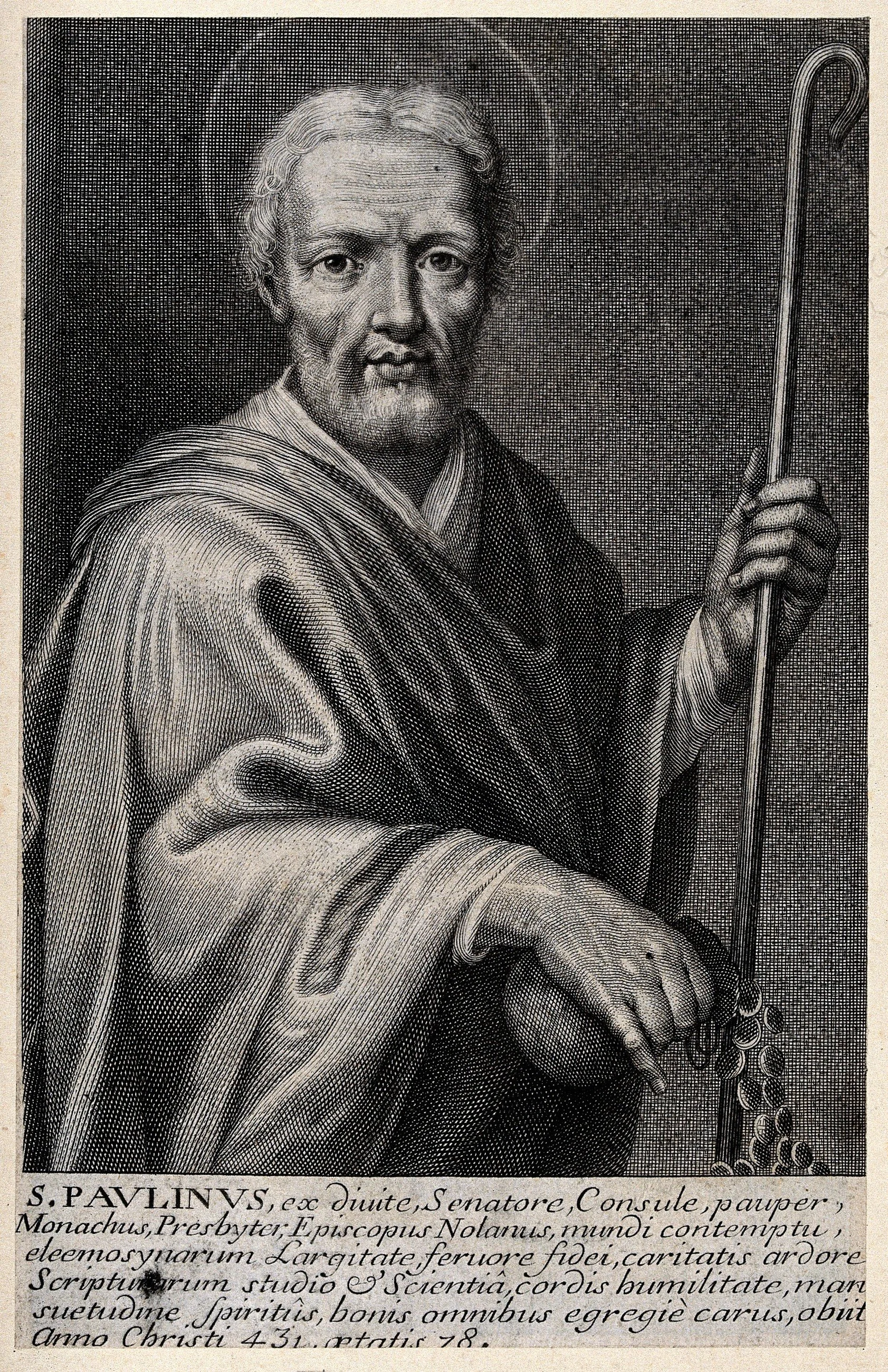
Saint Paulinus of Nola in a 17th-century line engraving signed “De Larmessin” and published in Paris by J. Couterot and L. Guérin. He holds a staff resembling a crozier in one hand and a purse spilling coins in the other. The Latin text below calls him a rich man, senator, consul, pauper, monk, priest, and bishop of Nola, and records his death in 431 at age 78. Born in Bordeaux, Paulinus governed Campania around 380, later gave up his career, settled at Nola in 395, and became its bishop around 410.
Image: Nicolas de Larmessin (engraver), CC BY 4.0, via Wellcome Collection and Wikimedia Commons
Paulinus was a bishop in Campania around the turn of the fifth century, and later writers connected his name, Nola, and the region of Campania with Latin terms used for bells. That neat story hardened into an origin legend.
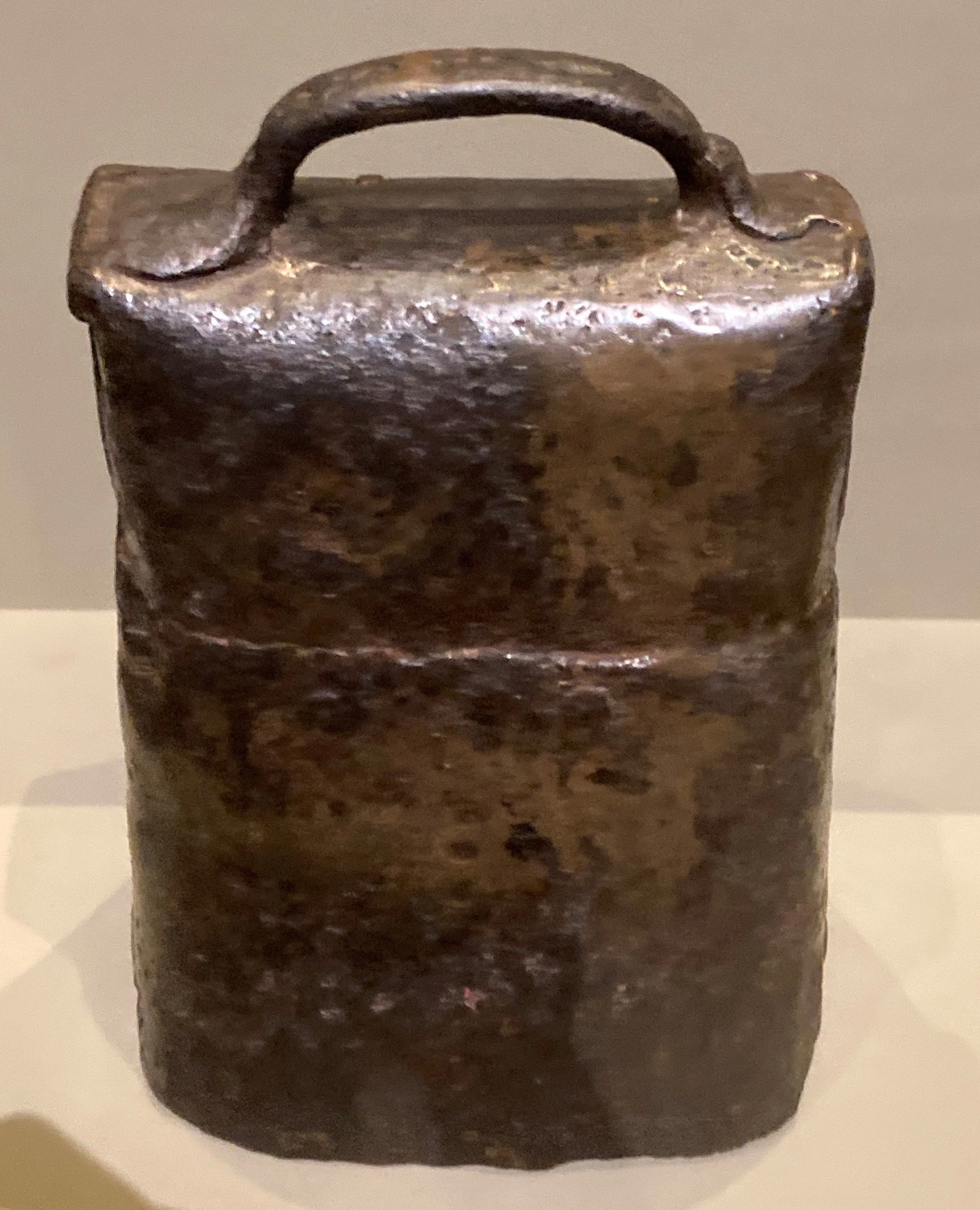
St Patrick’s Bell, an iron hand-bell coated in bronze, on display at the National Museum of Ireland in Dublin. It stands 20 cm high, weighs 1.7 kg, and was made from two sheets of iron hammered into shape and joined with rivets. Tradition links it to Saint Patrick, and around 1100 it was enclosed in an ornate metal shrine. Hand-bells like this are among the most numerous surviving early medieval relics in Ireland and were passed down through generations of abbots and clerics. In the Middle Ages one form of handbell was called a nola, after the supposed origin of bells in Paulinus’s town.
Photo: Ceoil, CC BY-SA 4.0, via Wikimedia Commons
The problem is that Paulinus described churches in considerable detail and never mentioned inventing or introducing bells. Historians instead see Christian bell use developing gradually from earlier sounding devices and monastic signals.
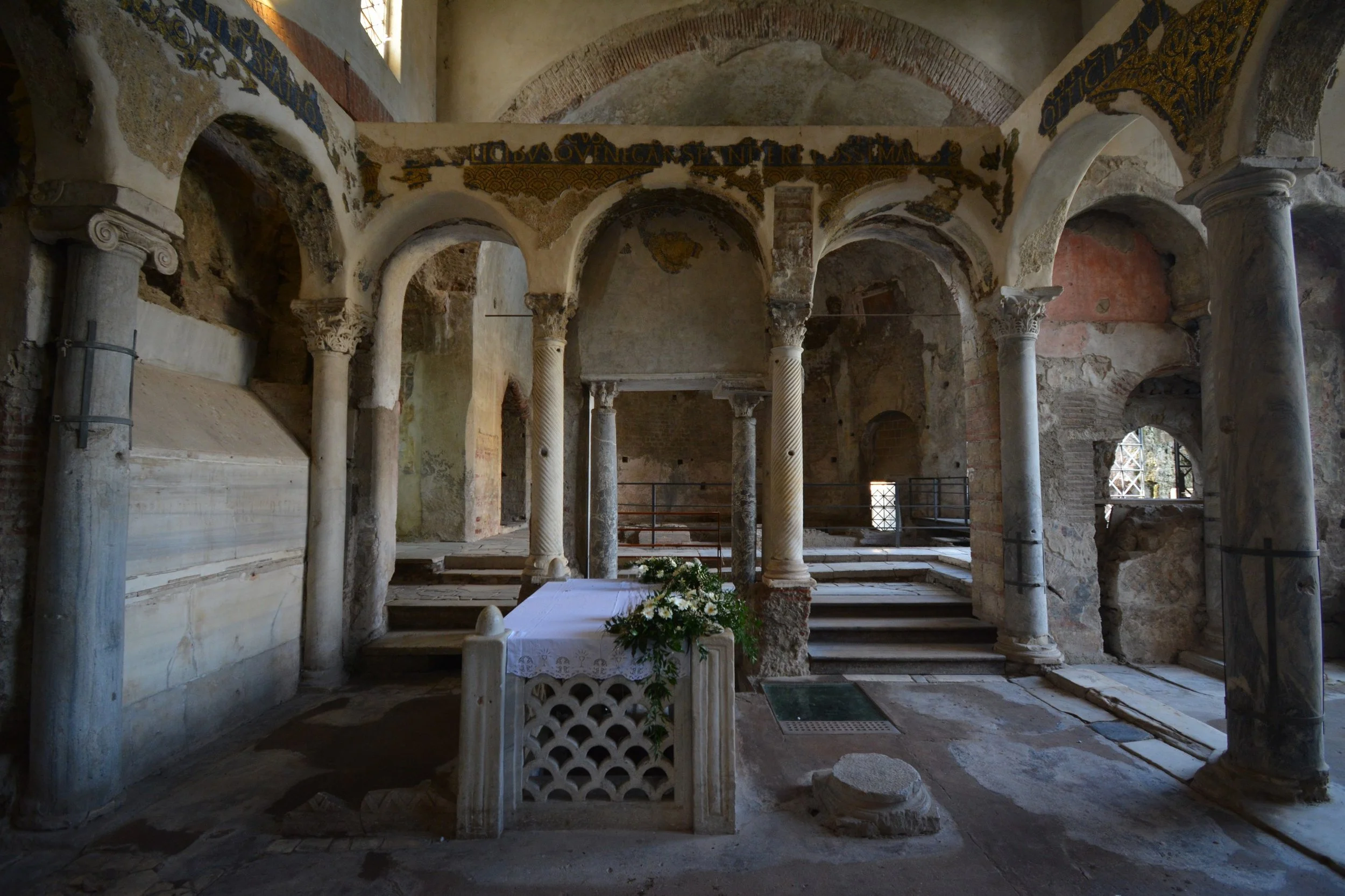
Inside the Basilica of San Felice, part of the early Christian basilica complex at Cimitile, just outside Nola, photographed in January 2023. Paulinus settled here beside the tomb of the third-century martyr Felix, rebuilt the complex, and added a new basilica between 401 and 403. He described the buildings and their decoration in a long letter to Sulpicius Severus, including the apse mosaic and the inscription he wrote for it. Between 484 and 523 an aedicule decorated with mosaics on a gold and blue ground was built around the tombs of Felix and Paulinus.
Photo: MentNFG, CC BY-SA 4.0, via Wikimedia Commons
That version is less tidy but more believable. Technologies as ordinary as public bells rarely appear because one famous person had a single bright idea. They spread because communities kept finding uses for a sound that could organize people at a distance.

A nun strikes a wooden semantron with two mallets at Pasărea Monastery, a convent 29 km east of Bucharest, Romania, in July 2011. Eastern Orthodox monasteries sound the semantron to call monastics to prayer. Its use has been traced to at least the early 6th century, when it replaced the trumpet as the call to assemble in the monasteries of Palestine and Egypt. The instrument both predates bells and substitutes for them.
Photo: Andrei Stroe, CC BY-SA 3.0, via Wikimedia Commons
Paulinus remains part of bell history, just not as the inventor the legend made him.
