
Before a bell entered service, medieval and later Catholic rites could treat it with a level of ceremony that sounds almost personal.
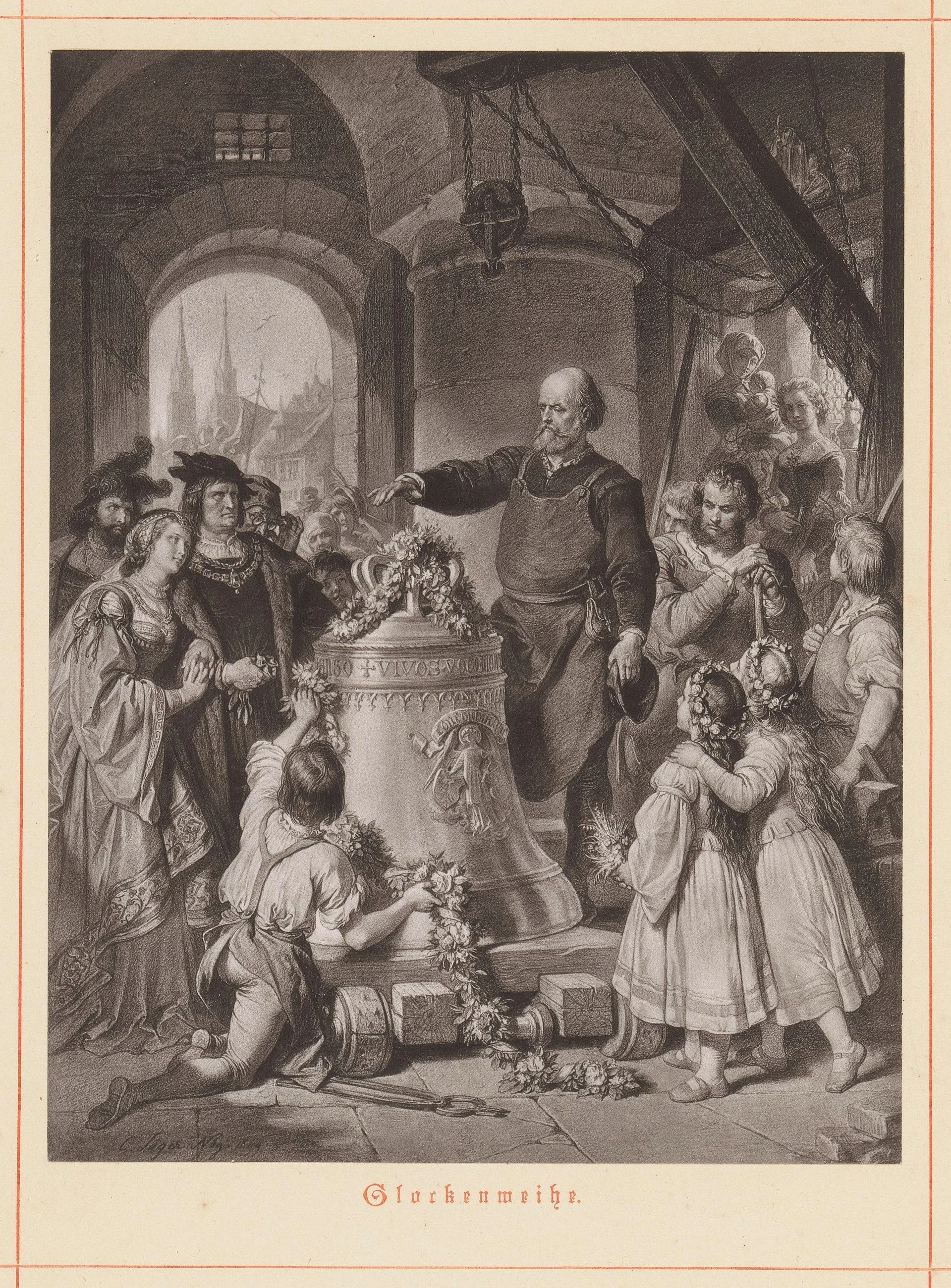
“Glockenweihe” (Bell Consecration), a collotype after a drawing by Carl Jäger, published by Friedrich Bruckmann in Munich around 1871 to 1881 and printed facing the title page of a book. The Rijksmuseum describes the scene as the consecration of a bell in a bell foundry. A man in an apron raises his hand over a new bell hung with flower garlands while townspeople, workers, and children gather around it. The bell carries the words VIVOS VOCO and the name CONCORDIA. In Friedrich Schiller’s 1798 poem “Das Lied von der Glocke,” the master founder calls his journeymen together to baptize the finished bell and names it Concordia.
Image: Carl Jäger (after a drawing by), CC0, via Rijksmuseum and Wikimedia Commons
The bell was washed with blessed water, anointed with holy oils, prayed over, and exposed to incense. It often received the name of a saint or patron. People commonly called the ceremony a “baptism of bells,” although church authorities distinguished it from sacramental baptism.
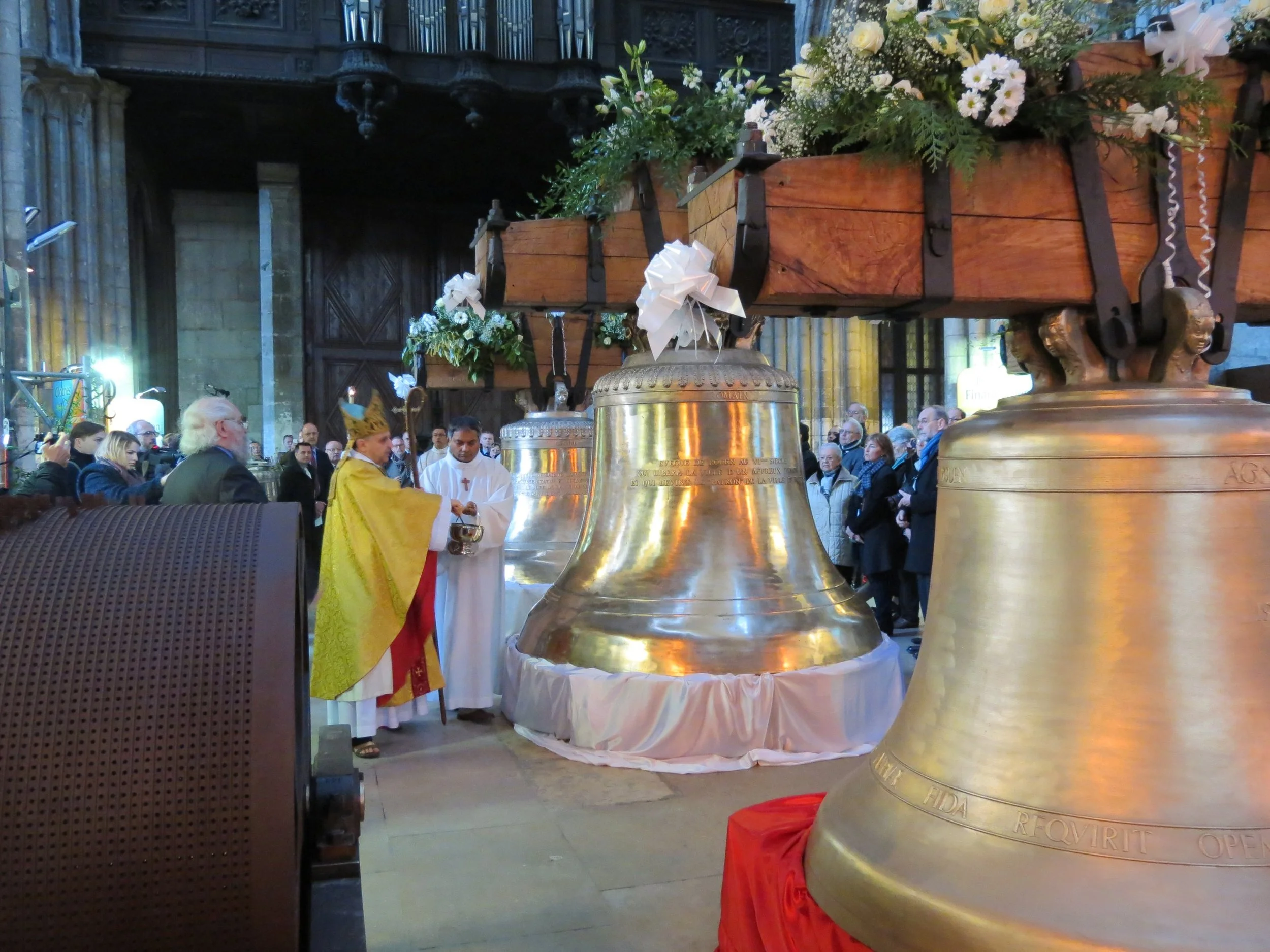
Archbishop Dominique Lebrun blesses the new bells of Rouen Cathedral on 3 April 2016. The bell in the center is Romain, one of three new bourdons cast for the restored carillon, named for Saint Romanus, a bishop of Rouen who died around 640. Its inscription calls him the patron of the city, and the new 64-bell carillon now hangs in the cathedral’s Tour Saint-Romain. In the rite summarized by the Catholic Encyclopedia in 1907, the bishop washes the bell inside and out with blessed water, anoints it with the oil of the sick in seven places outside and with chrism in four places inside, consecrates it in honor of a named saint, and places a thurible of incense and myrrh beneath it so the smoke fills its cavity.
Photo: Giogo, CC BY-SA 4.0, via Wikimedia Commons
The prayers explain why so much attention was paid to a piece of bronze. A bell was expected to call Christians to worship, mark the dead, announce feast days, and invoke protection in moments of danger. Some inscriptions gave the bell a first-person voice: I call the living. I mourn the dead. I break the lightning.
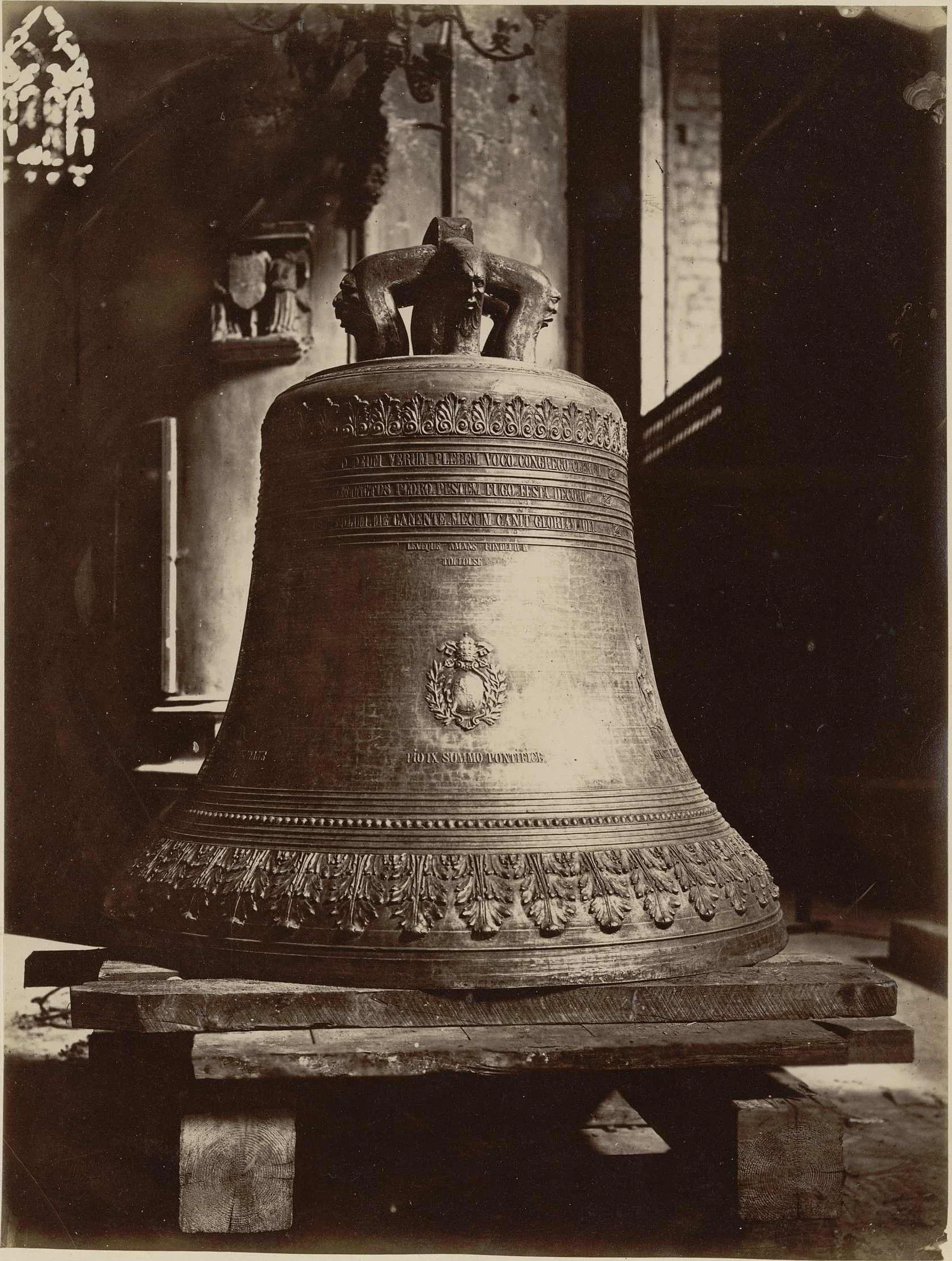
The bourdon Étienne-Florian of Toulouse Cathedral, photographed by Eugène Delon between 1876 and 1878. Signed “Levèque Amans, fondeur à Toulouse,” it was cast in 1876 from the metal of the Augustine, a mid-16th-century bell from the city’s Augustinian convent. It measures 1.82 m across, weighs 3,950 kg, and was called the Floriane after Cardinal Florian Desprez, archbishop of Toulouse. Its inscription asks Saint Stephen, the cathedral’s patron, to pray for us, and opens in the bell’s own voice: LAUDO DEUM VERUM PLEBEM VOCO CONGREGO CLERUM DEFUNCTOS PLORO PESTEM FUGO FESTA DECORO (“I praise the true God, I call the people, I assemble the clergy, I mourn the dead, I put plague to flight, I adorn the feasts”). The Catholic Encyclopedia notes that these lines, usually with “nimbum fugo” (I scatter storm clouds), were often used in bell inscriptions.
Photo: Eugène Delon, Public domain, via Archives municipales de Toulouse and Wikimedia Commons
Once it entered the tower, people learned that voice. The ritual did not pretend the metal was alive, but it did assign the bell a public identity and a job.
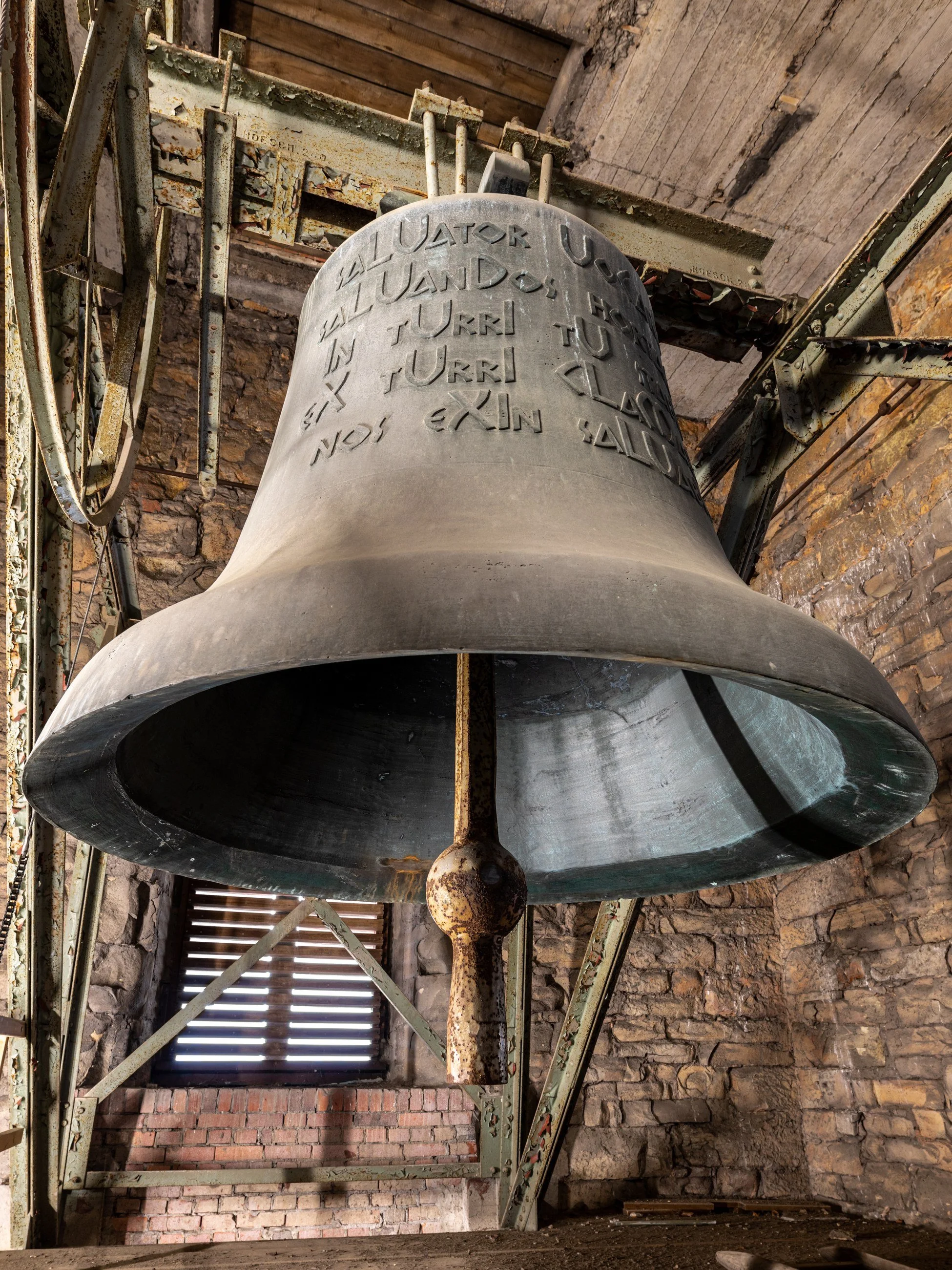
The Salvator bell in the tower of St. Viktor, the oldest church in Dülmen, Germany, photographed in October 2021. Cast in 1964 by Petit & Gebr. Edelbrock of Gescher, it is the largest of the church’s six bells, 1,825 mm across and weighing 3,850 kg. Its Latin inscription begins with its name, SALVATOR, and includes the words IN TURRI and EX TURRI (in the tower, from the tower). Each of its five companions also has a name: Viktor, after the church’s patron saint, Michael, Maria-Martha, Christus König, and Gabriel.
Photo: Dietmar Rabich, CC BY-SA 4.0, via Wikimedia Commons
