
Jamestown archaeologists had fragments of a bell that broke before 1610. Four centuries later, a bellfounder used those pieces to reconstruct its shape.
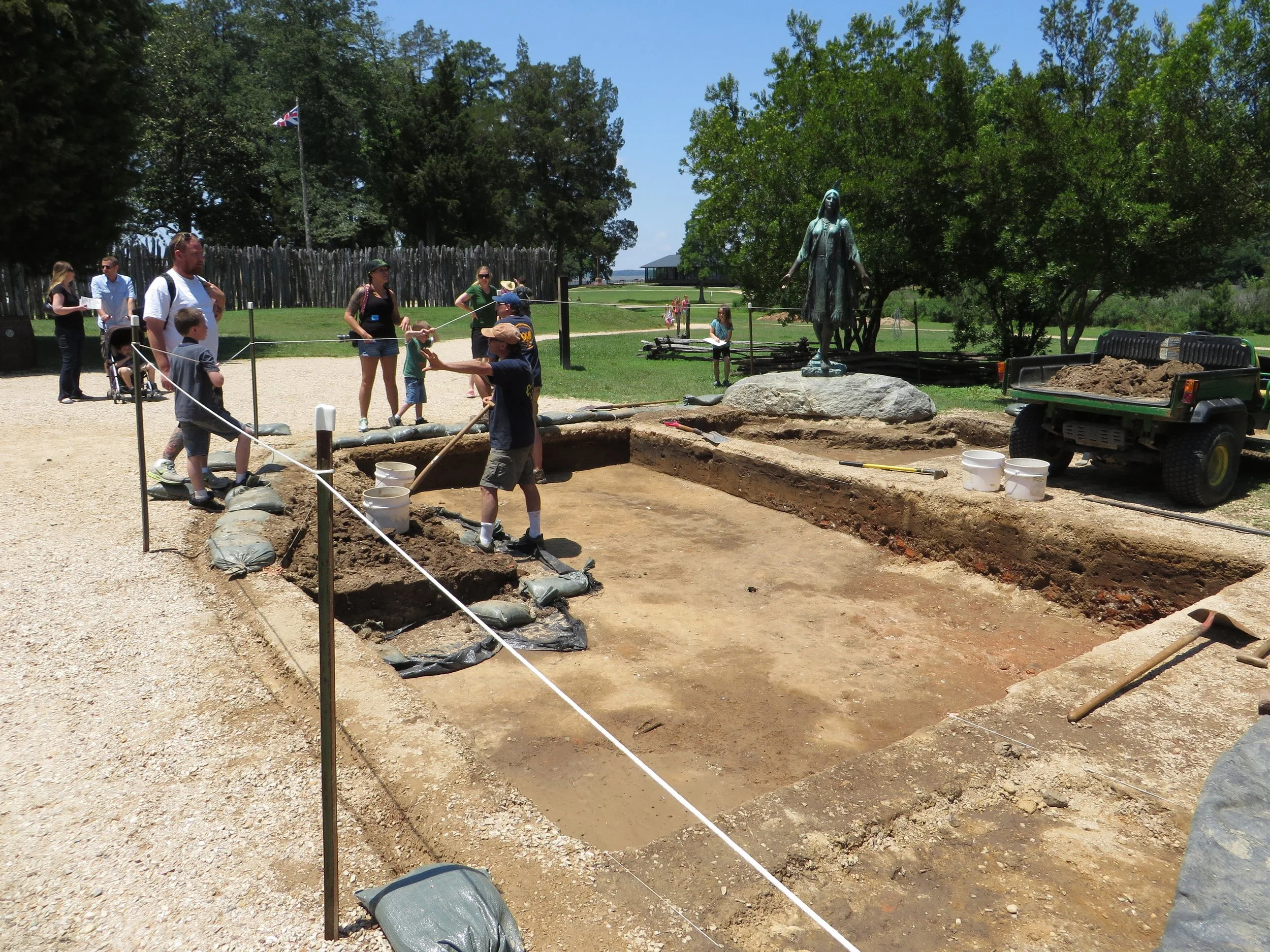
Visitors watch an open excavation at Historic Jamestowne on 14 June 2014, next to William Ordway Partridge's bronze statue of Pocahontas, dedicated in 1922. Historic Jamestowne says the statue was moved a few feet west that year to make way for more archaeological work. The Jamestown bell is known from four fragments. Construction crews building the seawall at the western tip of Jamestown Island found the first one in the early 20th century, and Jamestown Rediscovery archaeologists later found three more at the James Fort site. One came from the fort's west bulwark ditch, which the colonists had filled in by 1610.
Photo: Ken Lund, CC BY-SA 2.0, via Flickr and Wikimedia Commons
The surviving fragments represented different parts of the original profile, which gave founder Benjamin Sunderlin enough information to model a replacement. The pieces were scanned, the profile rebuilt, and a new mould made using traditional bellfounding methods.
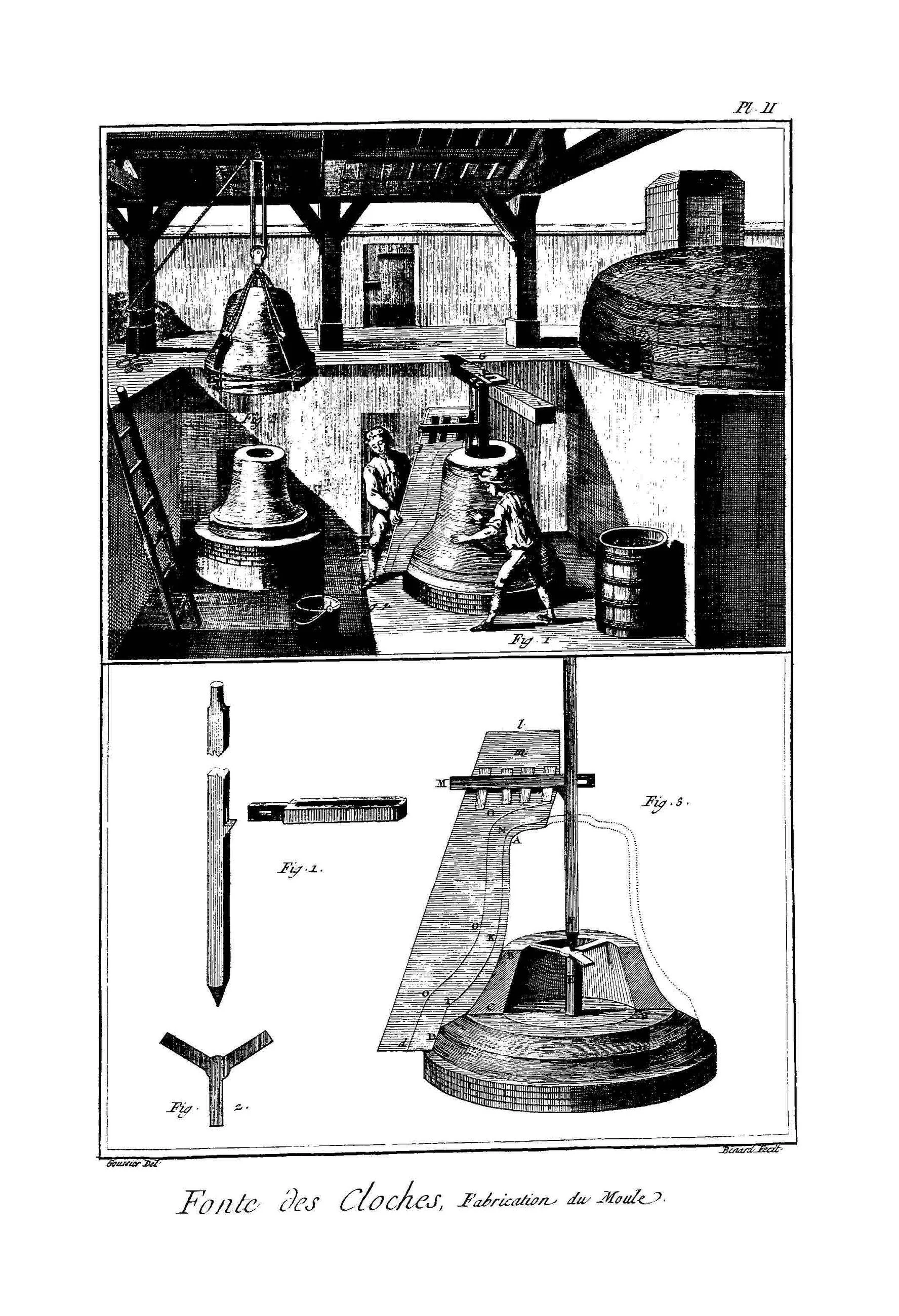
"Fonte des Cloches, Fabrication du Moule" (Bell founding, making the mould), plate II of the bell-founding series in the plates of Diderot and d'Alembert's Encyclopédie, published in 1767. It was drawn by Goussier and engraved by Bénard. Figure 3, at bottom right, is the founder's "compas": an iron spindle carrying a wooden board cut to the curves of the bell. The Encyclopédie's 1751 article "Cloche" explains that the board turns around the spindle to shape, in turn, a brick core coated with a cement of earth and horse dung, a model of the bell in earth finished with tallow and wax, and the outer mould, called the cope. A fire inside the mould then melts out the wax. Benjamin Sunderlin followed the same sequence for the Jamestown replica. Working from a wooden cutout of the bell's profile, he built the core, a wax-coated false bell, and the cope by hand from a loam of horse dung, hair, water, clay, and sand.
Image: Louis-Jacques Goussier (drawing) and Robert Bénard (engraving), Public domain, via Wikimedia Commons
The finished replica is about fifteen inches high and fifteen inches across at the mouth. It does not contain the original metal, so nobody can claim the new bell reproduces the exact lost tone. What it does reproduce is the geometry closely enough to make the object understandable again as a sound-producing tool rather than a handful of archaeological fragments.
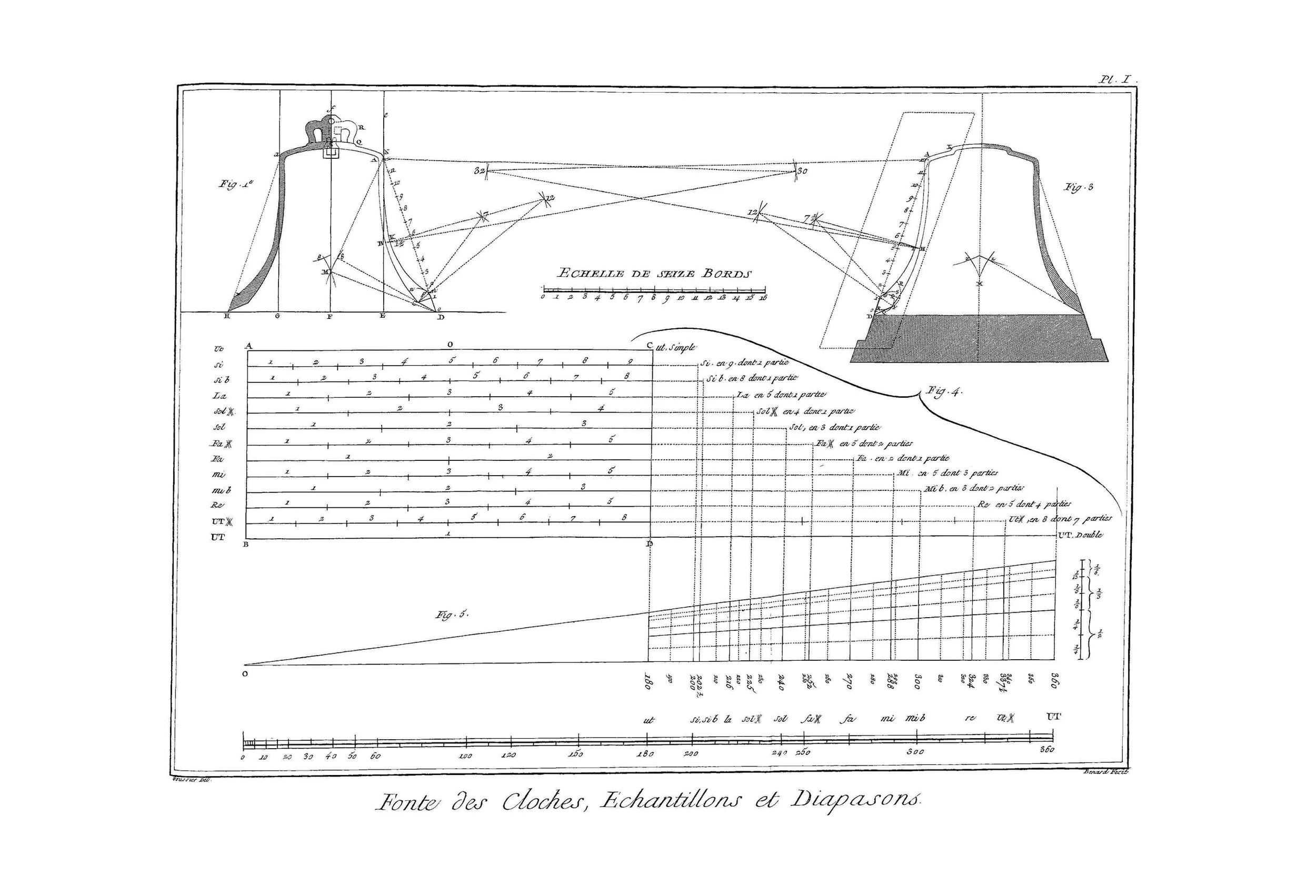
"Fonte des Cloches, Échantillons et Diapasons" (Bell founding, profiles and pitch scales), plate I of the same Encyclopédie series. Figure 1, at top left, constructs a bell's profile step by step with compasses. The 1751 article "Cloche" uses the thickness of the rim as the unit of measure: the diameter equals fifteen rim thicknesses, and the bell's height relates to its diameter as 12 to 15. The lower figures are scales, marked with musical notes, for sizing bells to sound different pitches. The same article warns that predicting a bell's sound from its shape and weight is subject to error, because the elasticity and cohesion of the metal would also have to be taken into account.
Image: Louis-Jacques Goussier (drawing) and Robert Bénard (engraving), Public domain, via Wikimedia Commons
That is the strange advantage of a bell reconstruction. You do not only get to look at the past. You can strike it.
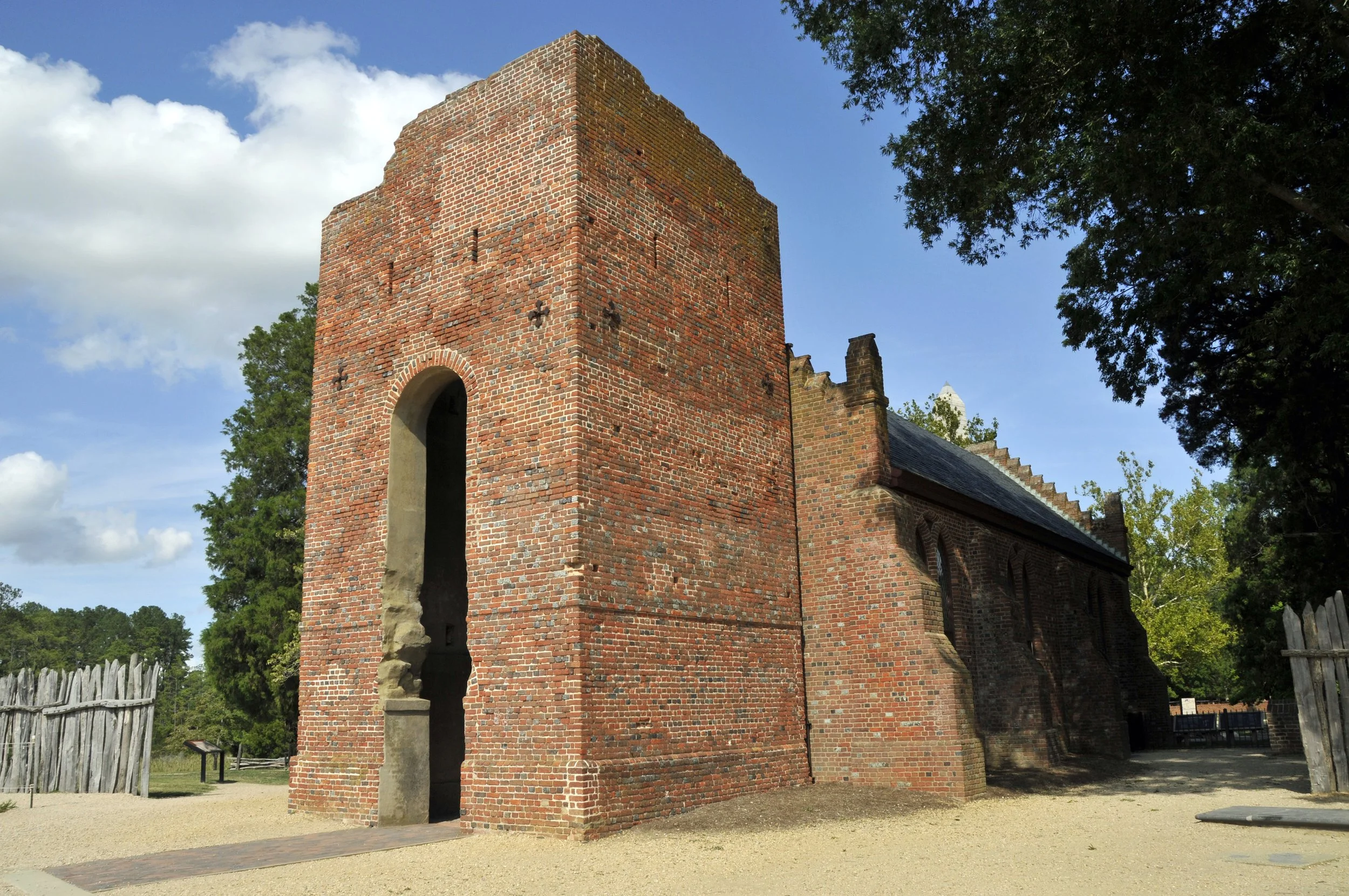
The brick church tower at Historic Jamestowne in August 2008, with the Memorial Church, built in 1907, beside it. Historic Jamestowne dates the tower to around 1680 and calls it the last surviving above-ground structure from Jamestown's time as Virginia's capital. A visitor in 1702 reported that the church had "a tower and a bell." The reconstructed bell is older than the tower. If it served as a church bell, the fragments suggest it hung in the first church, which stood near the center of James Fort from 1608 to 1617. In 1610 William Strachey, secretary of the colony, recorded that this church had two bells in its west end.
Photo: Tony Fischer, CC BY 2.0, via Flickr and Wikimedia Commons
