
Before newspapers, phones, or group messages, a death could become public through a bell pattern.

Scene 26 of the Bayeux Tapestry, an 11th-century embroidery, shows the body of King Edward the Confessor being carried to the church of St Peter the Apostle at Westminster. Two figures walk beneath the bier, each ringing a pair of handbells. Edward died on 5 January 1066. Photo: Université de Caen Normandie, CNRS, ENSICAEN, Public domain, via Wikimedia Commons
The passing bell might be rung while someone was dying to call neighbors to prayer. After death, the knell announced the loss more broadly. Local customs sometimes varied the number or sequence of strokes according to sex, age, or status, although the details were never universal.

An English full-circle church bell with a leather muffle fitted over one side of its clapper, photographed in 2017. A half-muffled bell gives a loud strike followed by a muffled one. Half-muffles are usually used for funerals and occasions of remembrance or mourning. Photo: Dougsim, CC BY-SA 4.0, via Wikimedia Commons
The same bell used for worship could therefore accompany a person at both ends of parish life. It called people into the church while they were alive and marked their death when they were gone.
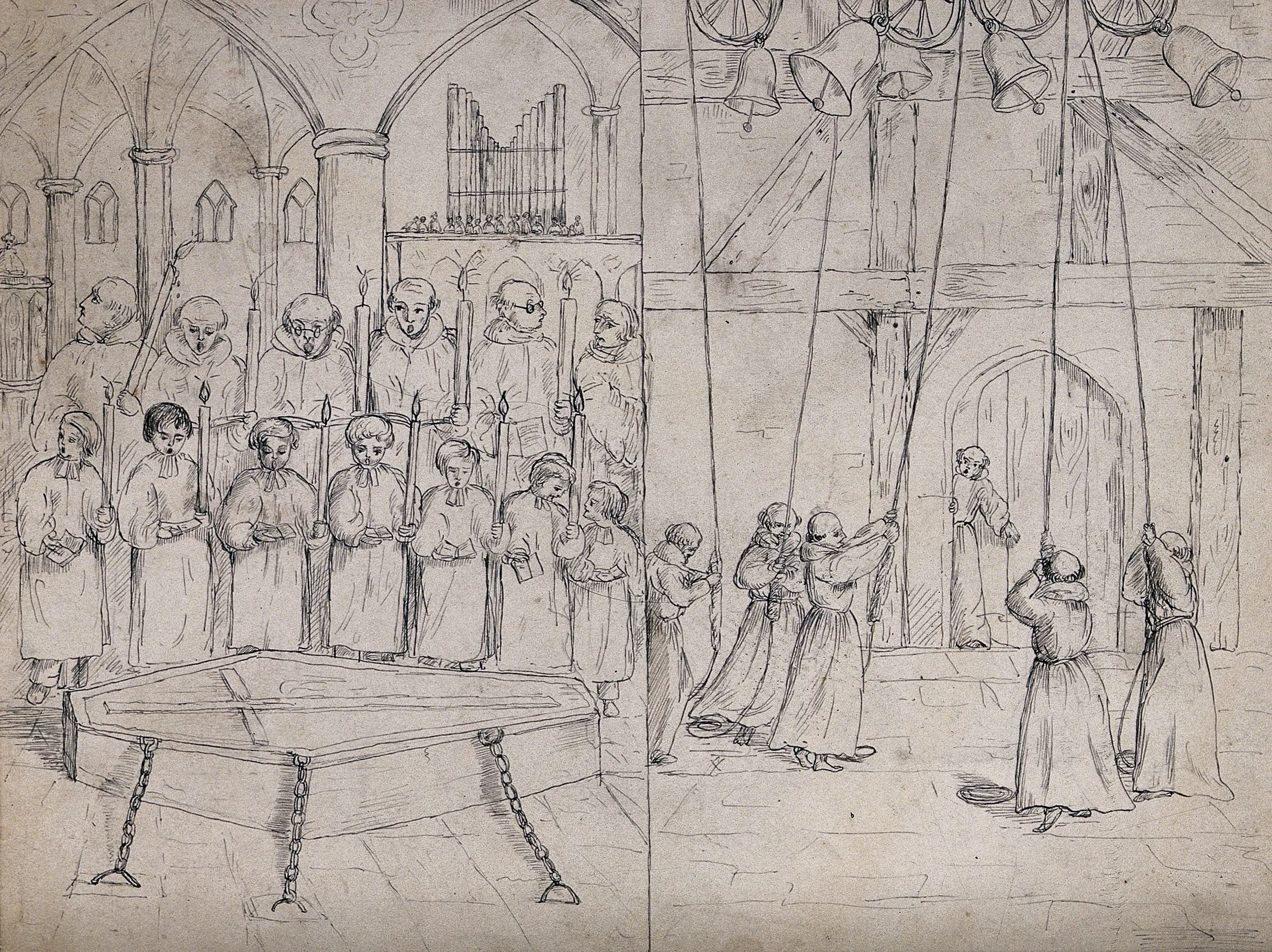
A pen and ink drawing in the Wellcome Collection. On the left, a choir with candles sings a mass for a person lying in a coffin. On the right, monks ring bells in a belfry. Photo: Wellcome Collection, CC BY 4.0, via Wikimedia Commons
That made grief audible beyond the household. Someone working outside the village could hear the tower and understand that a death had occurred without knowing yet whose death it was.
The news arrived as sound first. The name came later.
