
When a large church bell is struck and you hum back the note you heard, you are matching something the metal may not actually be producing. That sounds like a riddle, but it is one of the better documented findings in acoustics, and it took the better part of a century of careful experiments to pin down. I think the mechanism also says something useful about how communities hold together.
Start with what a bell physically does. A cast bell is a hollow shell that bends in many ways at once when the clapper hits it, and each of those patterns of bending vibrates at its own frequency. Bell founders in the Western church and carillon tradition gave the most prominent low ones names: the hum, the prime, the tierce, the quint and the nominal. In the familiar tuning ideal, the hum sits an octave below the prime, the tierce a minor third above the prime, the quint a fifth above it, and the nominal an octave above. Take an illustrative bell with a 500 Hz prime and an equal-tempered table gives you roughly 250, 500, 594.6, 749 and 1000 Hz, with many higher partials sitting on top of those.
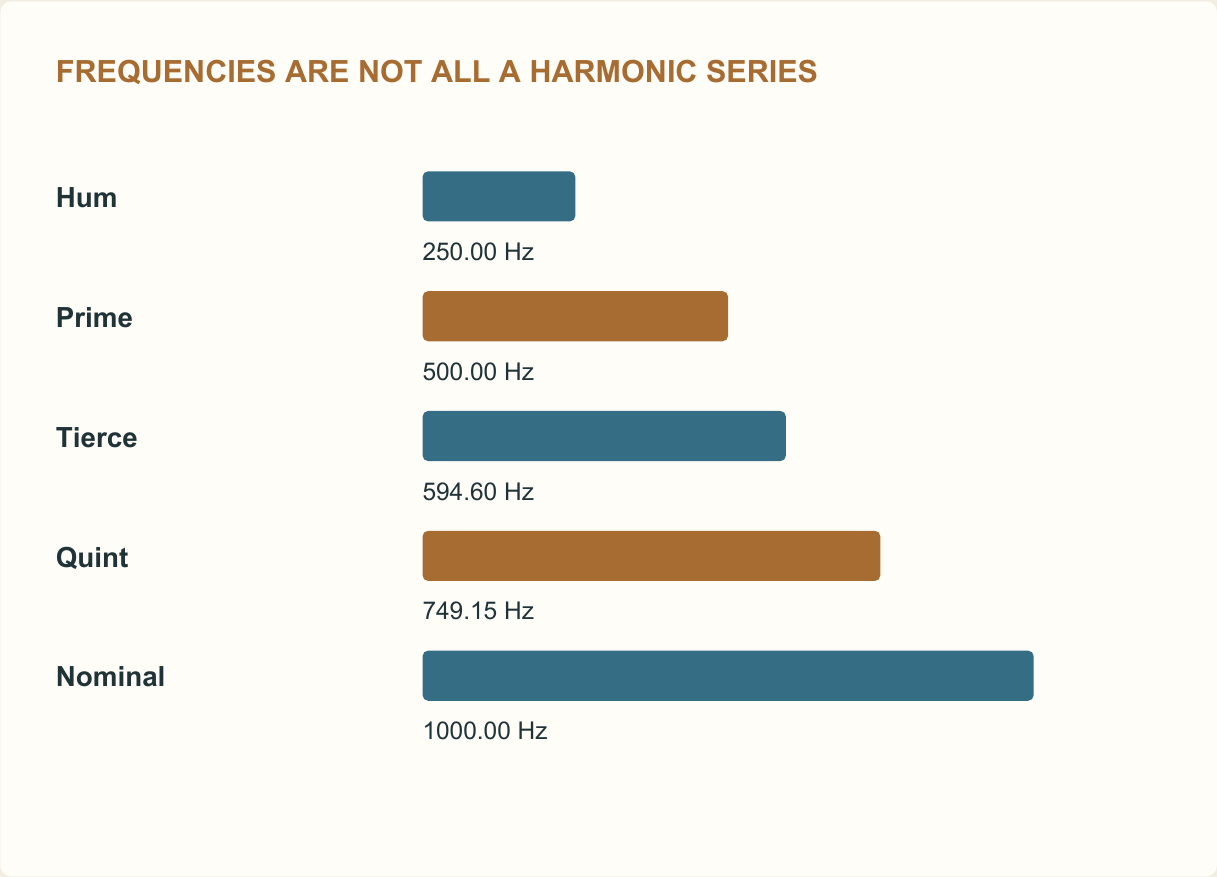
The five named partials of an illustrative minor-third bell with a 500 Hz prime, using equal-tempered tierce and quint. Diagram: The Science of Bells research atlas, p. 20.
Anyone who has studied music will notice that this is an odd set of numbers. A plucked string or a sung vowel produces a harmonic series, where every component is a whole-number multiple of one fundamental, and the ear has an easy time collapsing that stack into a single note. A bell does not do this. Its partials are, in the physicist's sense, inharmonic, and even a beautifully tuned bell keeps that minor third buried in its own voice. So the obvious question, which troubled people for a long time, is which of these vibrations is "the note." When a ringer says a bell is in D, where in the bronze is the D?
The answer that emerged is that the note people report, called the strike pitch, is often not located at any single vibration. It is inferred by the listener from the relationships among several higher ones.
The simplest way to see this is a laboratory trick called the missing fundamental. Play tones at 500, 750, 1000 and 1250 Hz together. Those are the second through fifth harmonics of 250 Hz, and many listeners will report hearing a common pitch at 250 Hz, even though nothing at 250 Hz was played. The auditory system notices that the components are spaced as if they belonged to one lower tone and supplies the tone. A bell is messier than this demonstration because its partials are not a clean harmonic series, but prominent upper partials that come close to such relationships can still suggest a lower common pitch, and that suggested pitch is what you hear as the bell's note.
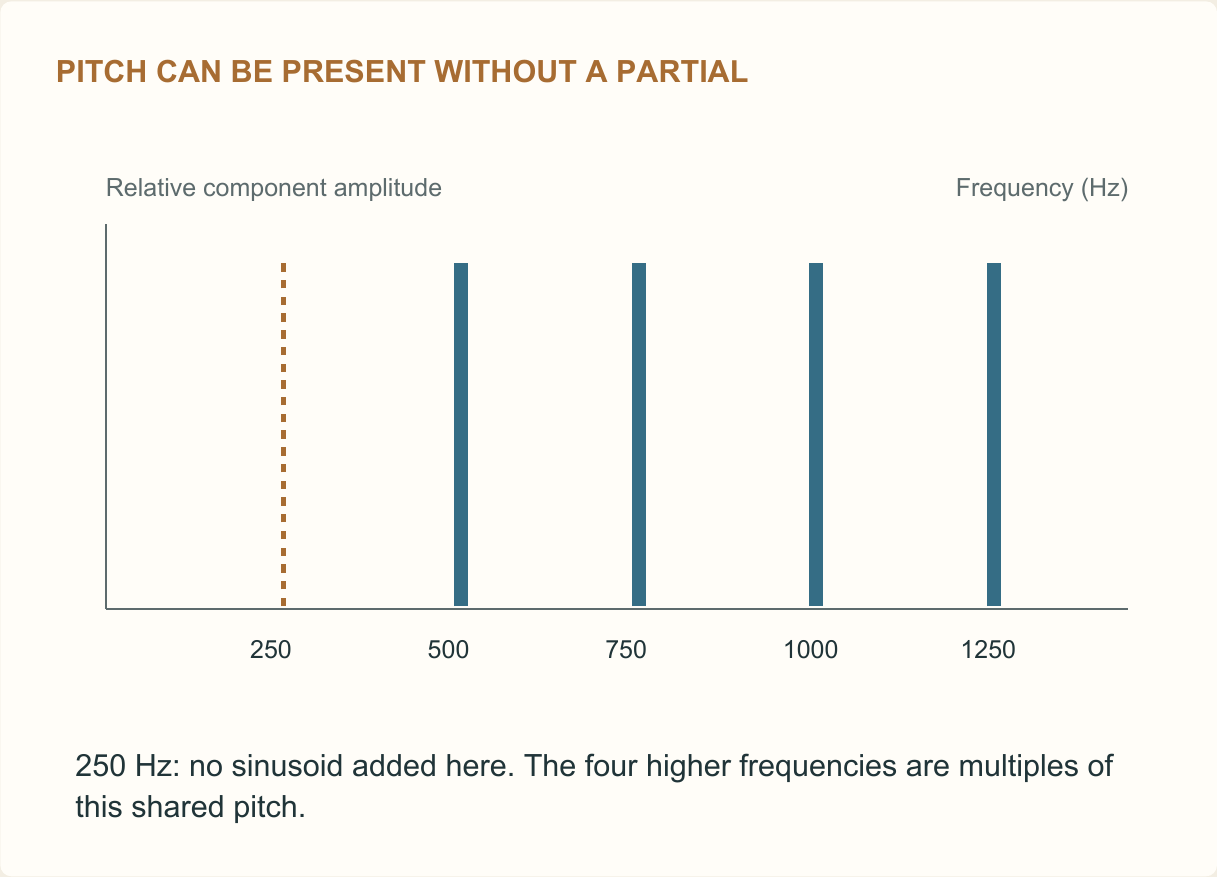
A synthetic missing-fundamental example: components at 500, 750, 1000 and 1250 Hz share a 250 Hz spacing, though no 250 Hz tone is present. Diagram: The Science of Bells, p. 22.
The history of how this was worked out is worth knowing, partly because a good piece of it is American. In 1928 Arthur Taber Jones published a study of the Harkness Memorial Chime at Yale, using microphones and oscillographs to examine the strength of individual components, and he connected the strike note to upper partials approaching a 2:3:4 relationship. In 1982 Terhardt, Stoll and Seewann published an algorithm separating the "spectral" pitches tied to individual components from the "virtual" pitches inferred from their relationships. In 1986 Eggen and Houtsma took recorded bell sounds, digitally altered selected partials, and measured how listeners' pitch judgments shifted, which is the kind of controlled test that actually establishes cause rather than just comparing two different bells and guessing. William Hibbert's doctoral work in 2008 pushed this further with listening experiments involving 30 subjects and a large body of bell measurements, and his results tie shifts in the perceived strike pitch to the spacing of the upper partials. That helps explain a thing ringers had long noticed, which is that two bells whose nominals agree can still be judged to sound at different pitches.
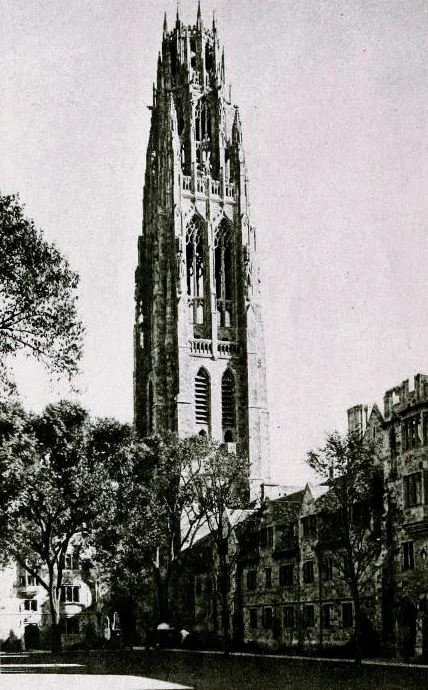
Harkness Tower at Yale, home of the Harkness Memorial Chime that Arthur Taber Jones studied, as published in Shadowland, November 1922. Photo: John Wallace Gillies, public domain, via Wikimedia Commons.
There is even neurological evidence pointing the same way. In 2005 Bendor and Wang reported neurons in the auditory cortex of marmosets that respond selectively to pitch, including to sounds with the fundamental removed. The source I'm working from is careful to say that this is evidence about neural representation in one experimental system and not a complete account of human musical experience, and I'd keep that caution. The puzzle has been constrained a great deal without being entirely closed, and individual listeners still differ in whether they lock onto the low inferred pitch or attend to the higher components.
None of this was purely academic, either. Bell founders and their critics argued over it for decades. Arthur Berwick Simpson, an English cleric, campaigned in 1895 and 1896 for bells to be in tune internally and not only with their neighbors, which helped popularize the hum, prime, third, fifth and nominal relationships. In 1935 Clinton Meneely of the Troy foundry told a gathering of engineering societies that five-partial tuning had been elevated into a false guarantee of quality, and he stressed the relative strength of components, consistency across a set of bells, and actual listening. Meneely had commercial reasons to say what he said, and some of his claims needed correcting, but he was pointing at something real: getting a few frequencies right does not by itself produce the voice you want, because the strength and decay of each partial matter as much as where it sits.
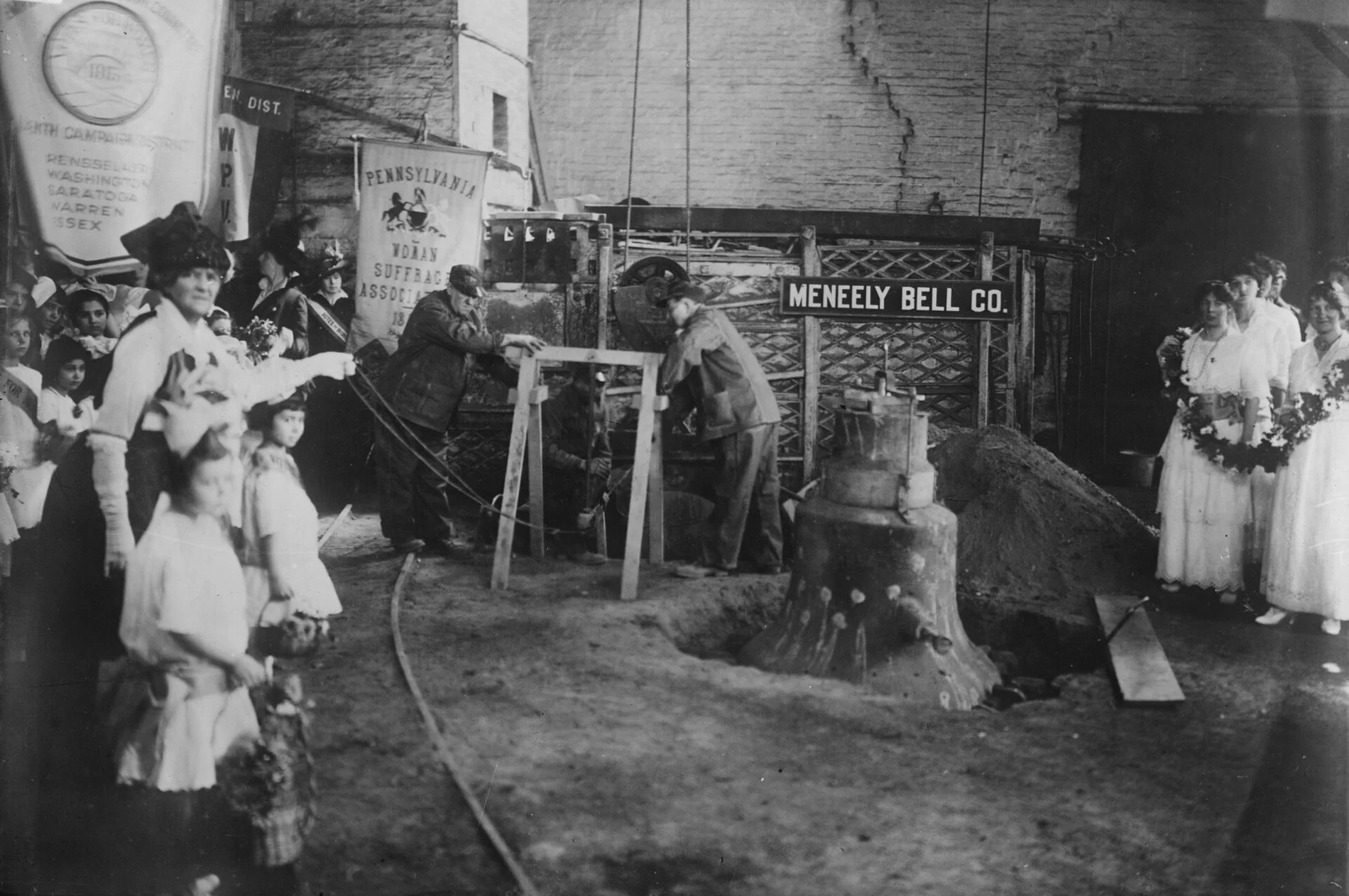
Casting of the Justice Bell at the Meneely foundry, 1915. Photo: Bain News Service, public domain, as reproduced in The Science of Bells, p. 14.
The bronze supplies a cluster of vibrations, some strong, some faint, some dying quickly, none of them simply "the note." The listener's ear and brain take the pattern and resolve it into a single pitch that feels as solid as the tower itself. The note is real in the sense that matters to anyone standing in the square, and people can agree on it and sing it back, but it exists in the relationship between the object and the people hearing it.
I find that a fair description of what a durable local institution actually is. A town has its separate parts, the parish and the volunteer fire company, the library board, the families who have been there four generations and the ones who arrived last year, and none of them alone is the town in the way none of the partials alone is the bell's note. What people experience as the community is something inferred from how those parts are spaced and how strongly each one sounds. When the relationships are good, the whole resolves into something people recognize and can hum back. When one part drops out or drifts, the perceived note shifts, sometimes before anyone can say exactly why, much as Hibbert's listeners heard a different pitch from bells that matched on paper.
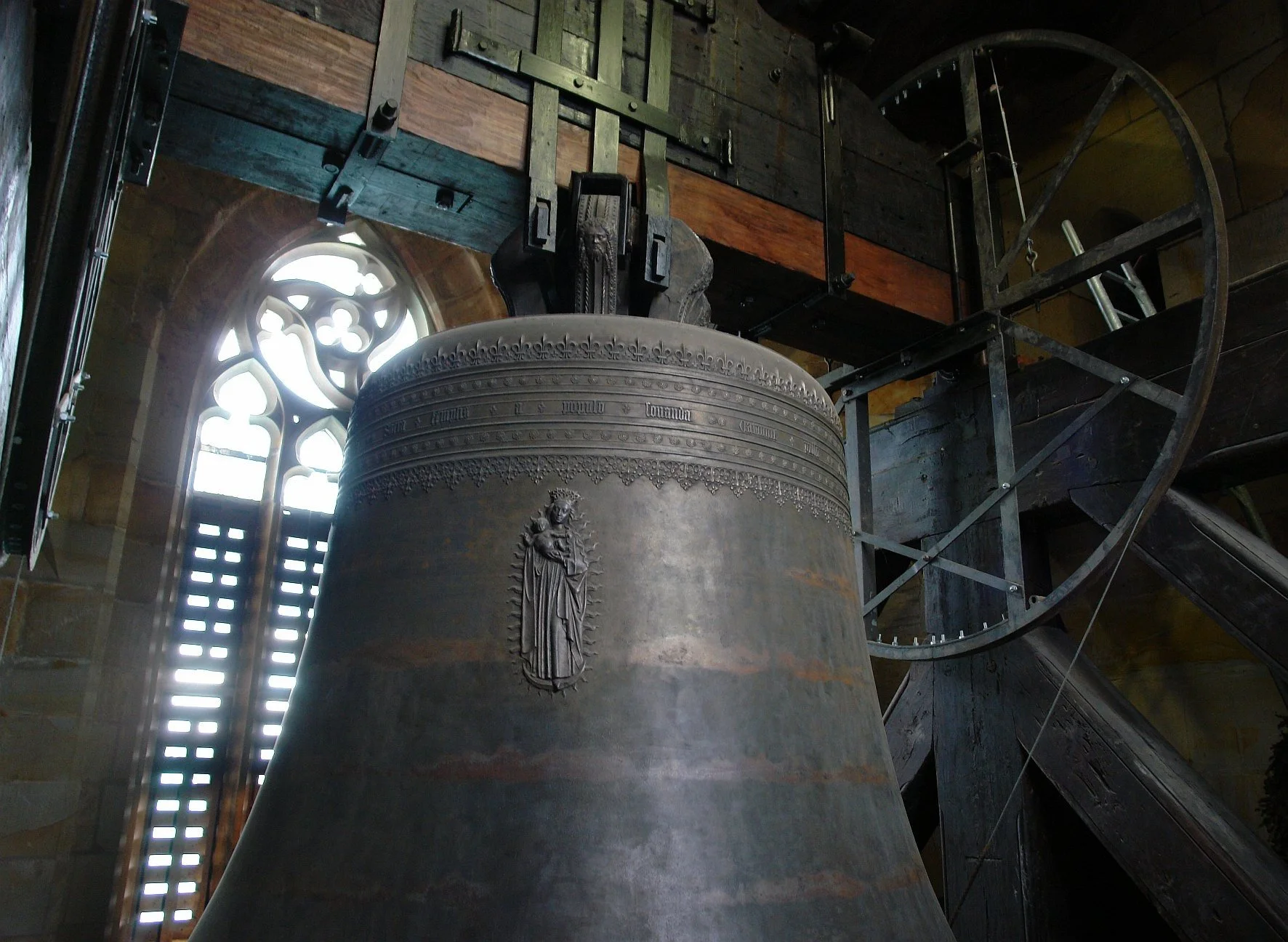
Maria Gloriosa in Erfurt Cathedral, cast by Gerhard van Wou in 1497; twentieth- and twenty-first-century repairs are part of its history. Photo: Kolossos, CC BY-SA 3.0, via Giant Bells: A Sacred and Civic History, p. 21.
This is also why tuning was always more than a recipe. Meneely's point about consistency across a set, and about listening instead of trusting a specification, applies well beyond foundries. You can satisfy every formal requirement for a civic organization and still end up with something that sounds wrong to the people it is supposed to serve, because what they respond to is the relationship among the parts and how it holds up over time.
There is a physical cost attached to all of this as well, which is worth saying plainly for anyone thinking about raising a bell. For bells of the same shape and material, doubling every dimension halves the frequencies and multiplies the mass by eight. A deeper voice that carries further over a town is paid for in bronze, in handling and in the structure that has to hold it up for a century or more. The low, steady note that a community can gather around is, quite literally, the expensive one, and that seems about right to me.
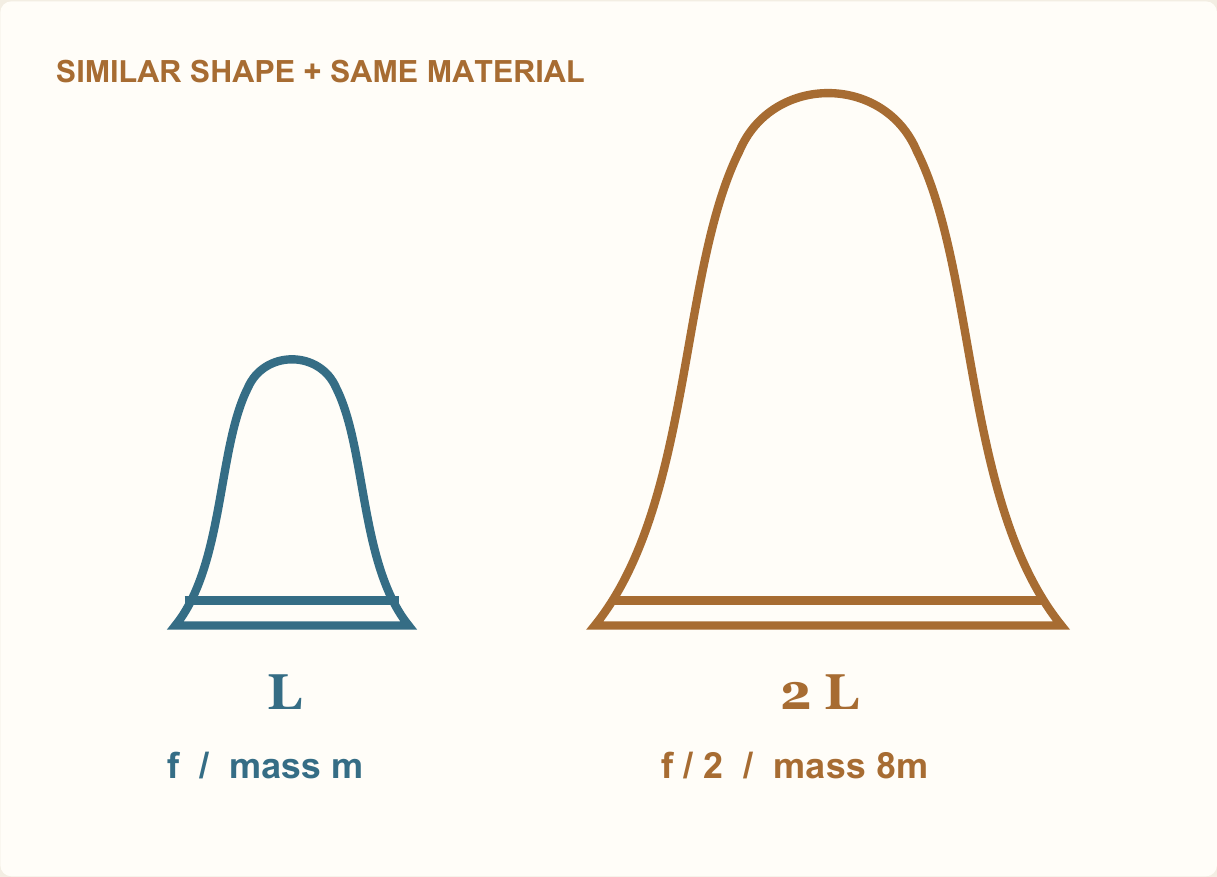
For bells of the same shape and material, doubling every dimension halves the frequencies and multiplies the mass by eight. Diagram: The Science of Bells, p. 21.
The research behind the strike note took roughly eighty years, from Jones listening to the Yale chime to Hibbert's listening panels, and it was built one controlled experiment at a time by people who mostly never met. A bell tower works on a similar schedule. The bronze is cast once, but the note is made again every time it rings, by whoever happens to be in earshot that day.
Read on X: https://x.com/BellTower1775/article/2110268049898995807
